Part 4 - What a Billionaire's Checklist Can Teach Us About Fixing Net Zero: Things the Public Can Actually Do
Article three in this series concluded that net zero's problem is not public opposition but communication: an abstract target losing out to vivid, immediate concerns, exactly as the modern Munger framework predicts. The practical follow-on question is what closes that gap for an individual person, right now, in a way that produces a visible result rather than another abstract commitment.
The twelve actions below follow that logic directly. Each is a real, currently open route into one of four pillars, energy, food, nature, and transport, split evenly at three each, and ordered from fastest and easiest to more involved.
Every entry is either free, paid to participate, automatically discounted, or grant-funded by the UK government or an established charity. None of them require believing in, quoting, or even mentioning "net zero" to take part, which is precisely the point established in article three: the goal does not need the label to be real.
These are just some examples, but framing net zero through action rather than words is a great way to engage.
Energy
1. Buy a home solar package from a supermarket. A low-cost solar route opens from 27 August 2026, when plug-in solar panels become legal for self-installation in England and Wales for the first time; Currys, B&Q, Amazon, and Lidl have all joined government plans to stock them, with panels expected to cost a few hundred pounds and pay for themselves in energy savings within about four years. GOV.UK, More families to benefit from lower bills through plug-in panels
2. Buy a stake in a local solar or wind project. Through the £1 billion Local Power Plan, Great British Energy is backing over 1,000 community-owned clean energy projects, from solar on schools and leisure centres to small wind and hydro schemes. Local people can typically invest from £100 to £250 in a community share offer and receive a return while keeping the profits in the area rather than with a distant utility. Great British Energy, Local Power Plan
3. Start or join a community energy group. The Great British Energy Community Fund offers up to £140,000 in staged grants, covering feasibility studies and development costs, to parish councils, charities, faith groups, sports clubs and community interest companies that want to install rooftop solar, battery storage, or heat networks on shared buildings. UK GEI, Great British Energy Community Fund 2026
Food
4. Give away food that would otherwise be wasted, or collect it for free. More than 600 community fridges now operate across the UK, letting households and businesses donate surplus food and anyone in the area take what they need at no cost, with new sites still opening. Resource, Community Fridge Network
5. Improve health, and cut back on meat for free, starting this month. Cutting back on red and processed meat lowers the risk of bowel cancer and heart disease and cuts NHS costs, according to the NHS and UK Parliament evidence, or try Veganuary, a UK-founded charity now in its twelfth year, offers a free 31-day starter kit for anyone wanting to try eating less meat, not no meat, including a celebrity cookbook, a plant-protein cookbook aimed at people who train or exercise regularly, and one daily email with recipes, meal plans, and nutritional advice, no cost and no commitment beyond January if a longer-term shift does not suit. Veganuary, sign up
6. Grow food in a shared space rather than changing what is bought. Community-led growing and orchard projects are funded through the Tree Council's Branching Out Fund, which gives small grants of £250 to £2,500 to community groups planting fruit trees, hedges and edible spaces in parks and public land. Devon County Council, Tree Council grants
Nature
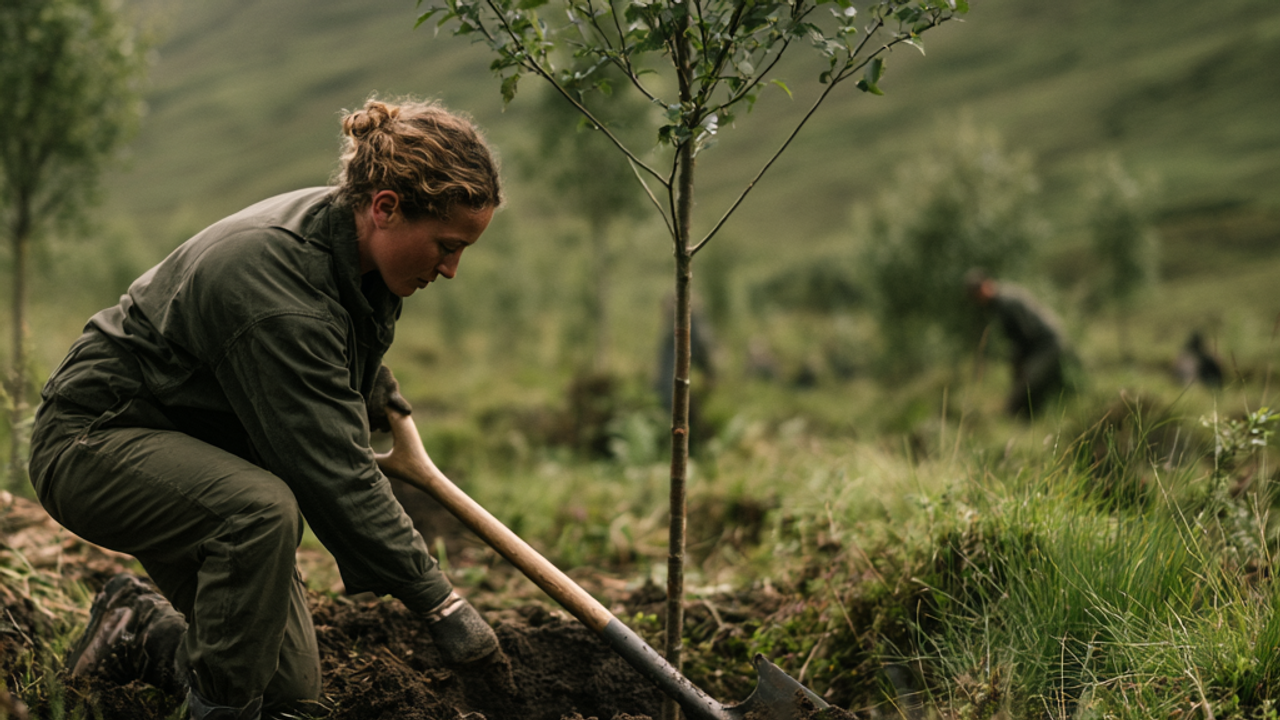
7. Plant trees on a single afternoon, no experience needed. The Woodland Trust and Trees for Life run regular volunteer planting days across the UK, providing tools, training and expenses, with options ranging from a single day to a residential week in the Scottish Highlands. Woodland Trust, Volunteer With Us; Trees for Life, Rewilding Weeks
8. Get paid or grant-funded to plant trees on land already owned. Individual landowners, farmers and smallholders can apply for government tree planting grants averaging around £19,000 per hectare for planting and establishment costs, alongside separate capital grants for hedgerows and boundary restoration. Tree Planting Grants, GOV.UK-backed scheme
9. Record wildlife on a phone and feed it into national data used for real conservation decisions. Apps such as iRecord, iNaturalist and Mammal Mapper let anyone log sightings of plants, insects, birds and mammals, with observations checked and used by the UK's official nature-monitoring bodies. UK Centre for Ecology & Hydrology, citizen science apps
Transport
10. Get an automatic discount on a new electric car with no form to fill in. The Electric Car Grant knocks £1,500 to £3,750 off eligible new electric cars priced at £37,000 or under, applied directly at the point of sale by the dealer or manufacturer. There is nothing to apply for or claim back. GOV.UK, Electric Car Grant
11. Get a home charge point funded without a driveway. Renters, flat owners, and households with only on-street parking can claim up to £500, 75 percent of the cost, towards installing an EV charge point, including cross-pavement charging solutions for homes with no off-street parking at all. GOV.UK, EV chargepoint grants
12. Get a bike, including an e-bike, for less than half price through work. The Cycle to Work scheme lets any employee whose employer takes part sacrifice salary before tax and National Insurance to hire a bike and safety equipment, typically saving 32 to 47 percent depending on tax band, with no upfront cost. Cyclescheme, Cycle to Work
How this connects back to net zero
Every one of these twelve actions maps directly onto emissions reduction, but they are deliberately not sold that way above, and that is not an oversight. Article three showed that abstract, distant framing is precisely what causes availability-misweighing and deprival-superreaction to work against public engagement. Each action above is instead framed around what it concretely does for the person taking it: money in hand, warmth, food, health, land, or a cheaper commute. That framing is not a trick. It is simply accurate, and it happens to be the framing the evidence says works.
Where the connection is worth stating plainly: home solar and community energy investment (actions one, two, and three) add clean generation capacity directly to the grid and cut reliance on gas-fired electricity. Reducing food waste (action four) tackles a source of emissions large enough that food waste alone, if it were a country, would rank as the third-largest emitter globally, since decomposing food waste in landfill produces methane, while shifting some meals away from meat (action five) targets the emissions and land-use footprint of livestock farming directly, a shift the UK's own climate advisers say is needed regardless of how it is framed. Tree planting and habitat recording (actions seven through nine) support both carbon sequestration and the sustainability-based side of the UK's climate commitments. Electric vehicle adoption and cycling (actions ten through twelve) address transport, the sector that overtook energy as the UK's largest source of emissions years ago.
The next article in this series looks at who is already building businesses to make each of these twelve actions easier to find, fund, or complete, and where the gaps still are.
Sources cited inline above via Soly, Solarinfo.uk, GOV.UK, Great British Energy, UK GEI, Resource, NHS, UK Parliament, The Guardian, Veganuary, Devon County Council, Woodland Trust, Trees for Life, Tree Planting Grants, UK Centre for Ecology & Hydrology, and Cyclescheme.
Ready to pressure-test your strategy?
Book a Strategy Sprint and get a clear, actionable plan for your climate venture.
Book a Strategy Sprint