Part 6 - What a Billionaire's Checklist Can Teach Us About Fixing Net Zero: Moving the Bottlenecks
Article four in this series set out twelve things the public can do, each one removing a small piece of the public-opinion brake that slows down the infrastructure clean power, food, nature, and transport transitions depend on. That list does not, by itself, make anything happen faster. It removes resistance.
This article looks at the engine underneath it: the physical, financial, and administrative bottlenecks that actually determine how quickly the UK can build the things it has already decided to build, once opposition is no longer the obstacle.
The analysis below starts from first principles rather than from any existing decarbonisation framework. It is built from a single question: for each thing that needs to get built, what is the actual rate-limiting step, measured in years, pounds, or trained workers, and what changes that rate. No target, deadline, or international commitment is treated as a starting assumption.
Bottleneck one: the grid connection queue
Wind and solar farms, batteries, and new demand from electrification cannot generate or use power until they have a physical grid connection. As of early 2025 that queue reached over 750 gigawatts of requested capacity, roughly four times what the UK actually needs to hit its clean power goals by 2030, because speculative and duplicate applications had clogged a first-come-first-served system alongside genuine projects. Mint Selection, grid queues bottleneck; Ofgem, State of the Market Energy Infrastructure Connection lead times as of 2026 vary from under a year in low-demand pockets of the network to the mid-2030s where transmission reinforcement is required, with the slowest regions gated by specific physical corridors such as Beauly-Denny in Scotland and the East of England transmission boundary. Feasibly, UK grid constraints and connection lead times 2026
What already works: the system operator has replaced the first-come-first-served queue with a "first ready, first connected" model, cutting the gross queue from 722 gigawatts to 283 gigawatts of offers through 2035, and reporting more than half the projects needed for 2030 clean power targets have now received a connection date. Guardian, renewable energy schemes able to plug into grid Ofgem has separately approved a five-year transmission investment settlement worth up to £90 billion, with penalties now attached to network operators that miss connection targets. Ofgem, connections reform package
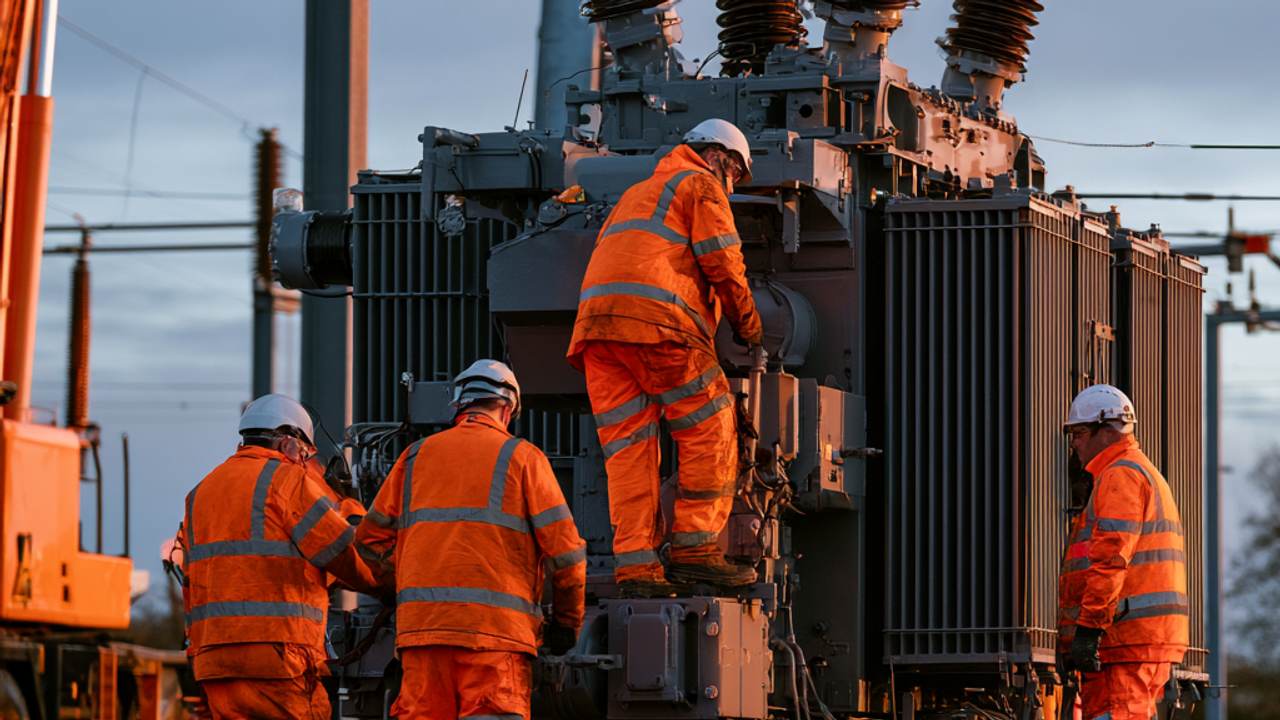
What still needs to be built: the £89 billion in additional post-2030 transmission investment the system operator says is required, plus the physical build-out of undersea cabling, which the operator recommends at three times the rate of new onshore lines specifically to reduce visible impact on communities and therefore opposition. Energy Connects, NESO £89bn post-2030 investment Delay has a directly quantified cost: the system operator estimates that pushing the recommended network design back by one, two, or three years adds £7.5 billion, £15.4 billion, and £24.8 billion respectively to the total transmission bill. NESO, network design delay cost analysis Speed here is not a matter of willingness. It is steel, cable, transformers, and the physical crews to install them, all of which take years regardless of how supportive the public or the government is.
Bottleneck two: planning and consenting time
Even a fully-funded, publicly-supported project cannot begin construction until it clears a formal consenting process. Before 2024, onshore wind in England was subject to a de facto ban through restrictive planning policy tests in place since 2015. Lifting that ban in July 2024 removed the policy barrier, but produced zero new onshore wind planning applications in the following months, because the barrier was never the only constraint. Supply chains, site agreements, and grid connection queues still had to catch up before developers had anything ready to submit. Guardian, zero onshore wind plans submitted since ban lifted This is direct evidence that policy signals and physical readiness are separate constraints, and removing one without addressing the other produces no measurable change in build rate.
What already works: the Planning and Infrastructure Act, which received royal assent in December 2025, removed the statutory requirement for mandatory pre-application consultation on nationally significant infrastructure projects, a change expected to cut up to 12 months from the typical planning timeline and save the industry an estimated £1 billion this Parliament. GOV.UK, fastest infrastructure building in a generation The same Act reintroduced large onshore wind and solar projects into the nationally significant infrastructure regime, set a capacity threshold of 100 megawatts, and introduced faster judicial review procedures for major infrastructure, projected to save up to six months where legal challenges arise. GOV.UK, onshore wind NSIP order; assets.publishing.service.gov.uk, judicial review reform
What still needs to be built: consistent delivery against the 17-month statutory decision target for nationally significant infrastructure, given that average pre-application time had actually doubled from one to two years since the regime began, before this Act's reforms took effect. GOV.UK, NSIP action plan A pylon compensation scheme, offering £250 a year for ten years to households within 500 metres of new transmission infrastructure, was introduced specifically to reduce the planning objections that have historically added years to transmission projects, though residents in the first wave of affected areas have publicly called the amount inadequate. ITV News, pylon compensation first wave; Telegraph, homes in shadow of pylons Whether that compensation figure needs to rise, and by how much, is itself an empirical question public-opinion research could answer directly, rather than guessing at a number.
Bottleneck three: skilled labour and installer capacity
Heat pump deployment is limited not by demand, grant funding, or electricity prices, but by the number of qualified installers physically available to do the work. The UK had roughly 5,000 to 6,000 MCS-certified heat pump installers as of 2026. Reaching a stated ambition of 600,000 installations a year by 2028 would require somewhere between 30,000 and 40,000 active installers, a five- to sevenfold increase in under two years. Renewable Ready, heat pump installer shortage report A Heat Pump Association survey of 250 installation businesses in May 2026 identified workforce development gaps as the single biggest constraint on rollout speed, ranking it above grant funding, electricity costs, and consumer awareness combined. ACR Journal, HVAC skills shortage Separately, the proportion of qualified HVAC installers actually doing heat pump work fell from 60 percent in early 2024 to 50 percent in early 2025, an active reduction in available capacity during the period rollout was supposed to be accelerating. ACR Journal, Wavin installer data
What already works: an £8 million Warm Homes Skills Programme subsidising retrofitting, insulation, and solar training, and a Heat Training Grant offering a £500 discount on heat pump and heat network courses, both intended to widen the installer pipeline. ACR Journal, skills funding schemes Analysis from the Aldersgate Group finds over 76,000 people in England already hold skillsets adjacent to heat pump installation, meaning the labour pool to convert exists, it is not being converted at the rate required. Aldersgate Group, workforce planning for clean heat
What still needs to be built: a training and certification pipeline running at several times its current throughput, sustained over multiple years, since a skilled trade cannot be manufactured on the same timescale as a subsidy cheque. This is the same underlying constraint that slows down grid construction crews, transmission line engineers, and offshore wind technicians. Capital can be allocated in a single budget decision, a trained workforce cannot.
Bottleneck four: capital deployment and investor confidence
Large infrastructure with high upfront cost and long operating life, such as offshore wind or carbon capture, will not get built without a mechanism that gives investors confidence in future revenue. The UK's primary tool for this in electricity generation is the Contracts for Difference scheme, which has run annual competitive auctions since 2014, guaranteeing generators a fixed price for their output and shielding them from wholesale price volatility. Energy UK, Allocation Round 8 explained The same logic applies to heavy industry: the government has committed £21.7 billion over 25 years to the first two carbon capture clusters at Teesside and Merseyside, alongside a further £9.4 billion confirmed in the 2025 Spending Review, specifically to de-risk investment in a technology with no existing market price for its output. GOV.UK, £22bn carbon capture funding; Climate Change Committee, progress report 2026
What already works: the Contracts for Difference model itself, now in its eighth allocation round, has been the single most effective UK mechanism for scaling offshore wind, moving it from a marginal technology to the country's largest single source of low-carbon electricity, precisely because it solves the actual constraint, long-term revenue certainty, rather than a symbolic one. GOV.UK, CfD Allocation Round 8 The same logic has produced financial close on both the East Coast Cluster and HyNet transport and storage networks, with construction of carbon dioxide transport infrastructure now under way at both. Climate Change Committee, progress report 2026
What still needs to be built: a comparable long-term revenue certainty mechanism for the industrial sectors that still lack one, since only one UK manufacturing site, a cement plant in Padeswood, Wales, has so far reached a final investment decision on carbon capture, despite manufacturing being the largest single emissions category in any breakdown of the problem. Climate Change Committee, Padeswood cement CCS This sector has no public-facing consumer lever, unlike every action in article four, which means its speed depends entirely on capital mechanisms and industrial policy, not public opinion or behaviour.
Putting the four bottlenecks together
Public support removes a political brake. It does not add a single transmission cable, train a single heat pump installer, or shorten a single planning examination. Those are physical and administrative processes with their own fixed timescales, and the evidence above shows each one has already been identified, and in most cases already has a reform programme under way, independent of whether the public is on board.
The actual sequencing logic runs like this. Public support prevents a project from being delayed or cancelled by opposition once it reaches the planning stage, which is exactly what the twelve actions in article four contribute to. Planning reform determines how quickly a ready project clears consent once support exists. Capital mechanisms determine whether a project is financeable once it clears consent. Grid capacity and skilled labour determine whether a financed, consented project can physically be built and connected once money and permission are both in place. A bottleneck at any one of these four stages caps the system's overall speed regardless of how fast the other three move, which is why lifting the onshore wind ban alone, in isolation, produced zero new applications: three of the four stages were still unresolved.
This reframes the practical question. Rather than asking how to make the public more supportive of a general target, the more useful question is which of the four bottlenecks is currently binding for a specific project type, and what fixes that one bottleneck. For onshore wind today, planning reform and grid connection reform have both moved; the binding constraint is now largely supply chain and installer capacity. For industrial carbon capture, the binding constraint is capital mechanism design, since only one site has reached financial close. For heat pumps, the binding constraint is training throughput, not grants or public appetite, which UK survey data already shows is not the obstacle.
The final article in this series looks at who is already building businesses specifically to move these four bottlenecks faster, and where a founder could still start something new.
Sources
Mint Selection, grid queues remain a bottleneck
Ofgem, State of the Market Energy Infrastructure Highlights
Feasibly, UK grid constraints and renewable connection lead times 2026
Guardian, more than half of clean energy schemes now able to connect
Ofgem, major reform package to accelerate grid connections
Energy Connects, NESO lifts post-2030 investment need to £89bn
NESO, network design delay cost analysis, August 2026
Guardian, de facto ban lifted on building onshore windfarms
Guardian, zero onshore wind plans submitted since de facto ban lifted
GOV.UK, fastest infrastructure building in a generation
GOV.UK, Infrastructure Planning (Onshore Wind and Solar Generation) Order 2025
GOV.UK, streamlining infrastructure planning judicial review reform
GOV.UK, NSIP reforms action plan
ITV News, pylon compensation first wave branded an insult
Telegraph, more than 100,000 homes in shadow of pylons
Renewable Ready, UK heat pump installer shortage 2026
ACR Journal, skills shortages affecting UK and global HVAC market
Aldersgate Group, workforce planning for clean heat
Energy UK, Allocation Round 8 and Contracts for Difference explained
GOV.UK, Contracts for Difference Allocation Round 8
BBC News, government pledges nearly £22bn for carbon capture projects
Climate Change Committee, Progress in Reducing Emissions 2026 report to Parliament
Ready to pressure-test your strategy?
Book a Strategy Sprint and get a clear, actionable plan for your climate venture.
Book a Strategy Sprint